From 24th to 26th of September 2025 I attended the HPC status conference of the Gauss alliance in Goettingen, a lovely university city in Lower Saxony (my home area, btw ;-). As promised on Linkedin I will try to summarize the (personal) highlights of this event.
But before I start my report let me make two remarks:
1. Because of my health issues I am not able to hold out a full day of talks. Hence I skipped a few sessions, so there are some gaps in the conference programme I cannot report on.
2. As mentioned before (by writing „personal“) the „highlights“ are subjective.
The conference started on Wednesday at 2pm 🕑 with a short opening speech by Prof. Wolfgang Nagel, the chairman of the board of directors of the Gauß-Allianz (sorry for falling back to German ;-). Btw: the GA is an association of HPC centres in Germany, or as it is said on their website: „A non-profit association for the promotion of the scientific topic High Performance Computing”; for further details see https://gauss-allianz.de/en/about_ga/.
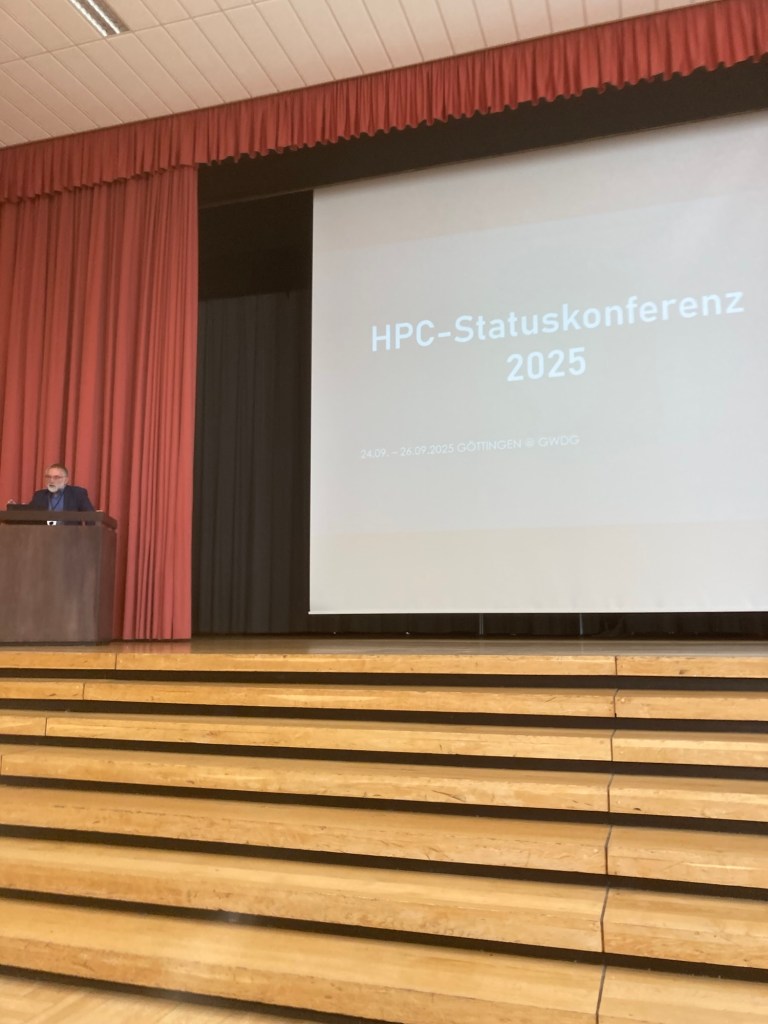
Afterwards Prof. Julian Kunkel gave on overview on „High-Performance Computing @ GWDG“, the latter being the hosting institution of this conference.

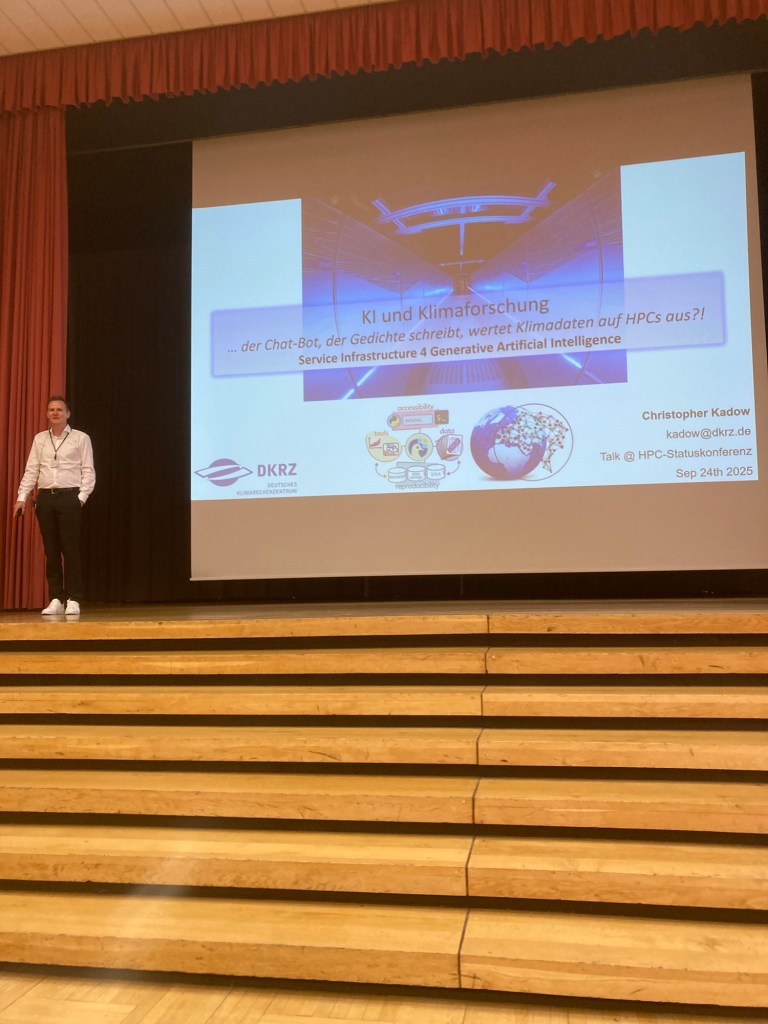
The first keynote titled „KI und Klimaforschung – der Chat-Bot, der Gedichte schreibt, wertet Klimadaten auf HPCs aus?!“ [AI and climate research – the chatbot, that is writing poems is analyzing climate data on high performance computers?!] was given by Dr. Christopher Kadow of DKRZ. This talk was full of facts and short project reports where HPC for climate research is enhanced by various AI methods, especially regarding data management and analysis. Tbh: this keynote overstrained me. 😉
The following coffee break as usual gave the opportunity for interesting conversations, e.g. I talked to a guy from Erlangen whom I know for a long time. He told me that money currently is not a problem: at least in Bavaria they get more money they can spend, at least when it is for an AI project. One of the presenters also said that it is hard to get money for traditional HPC only projects, the term AI is mandatory to get funding.
The next session was dedicated to various status reports:
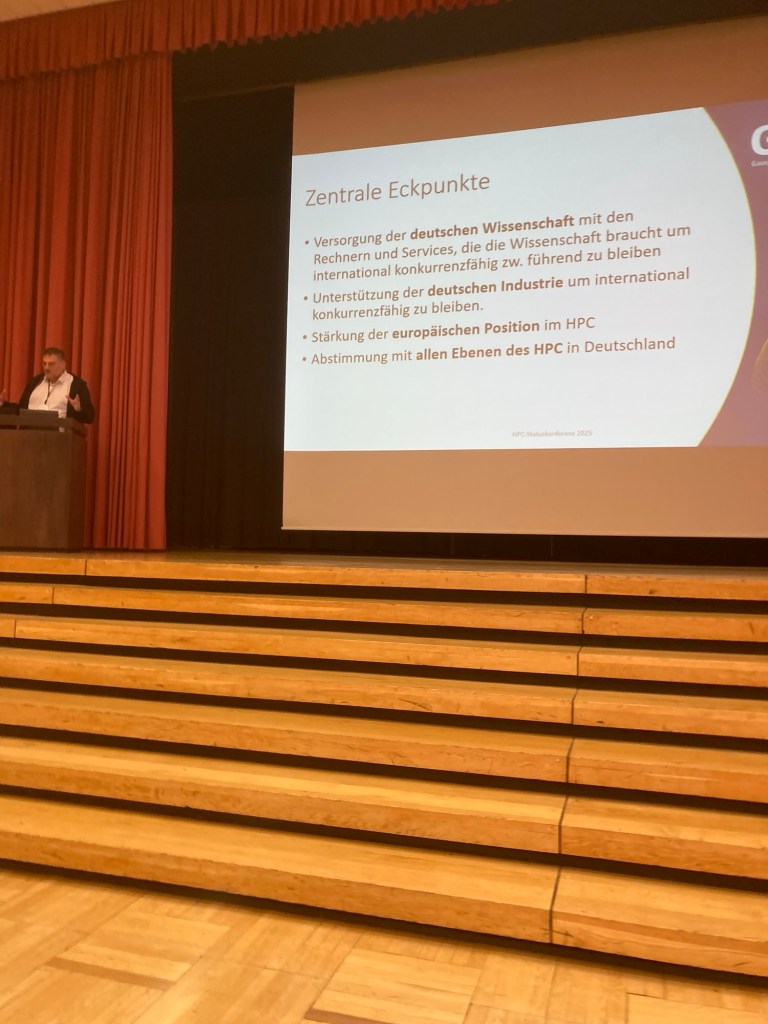
Prof. Michael Resch reported on the status and outlook of the Gauss Center for Supercomputing, the association of the three German tier-1 centres: FZJ, LRZ, HLRS

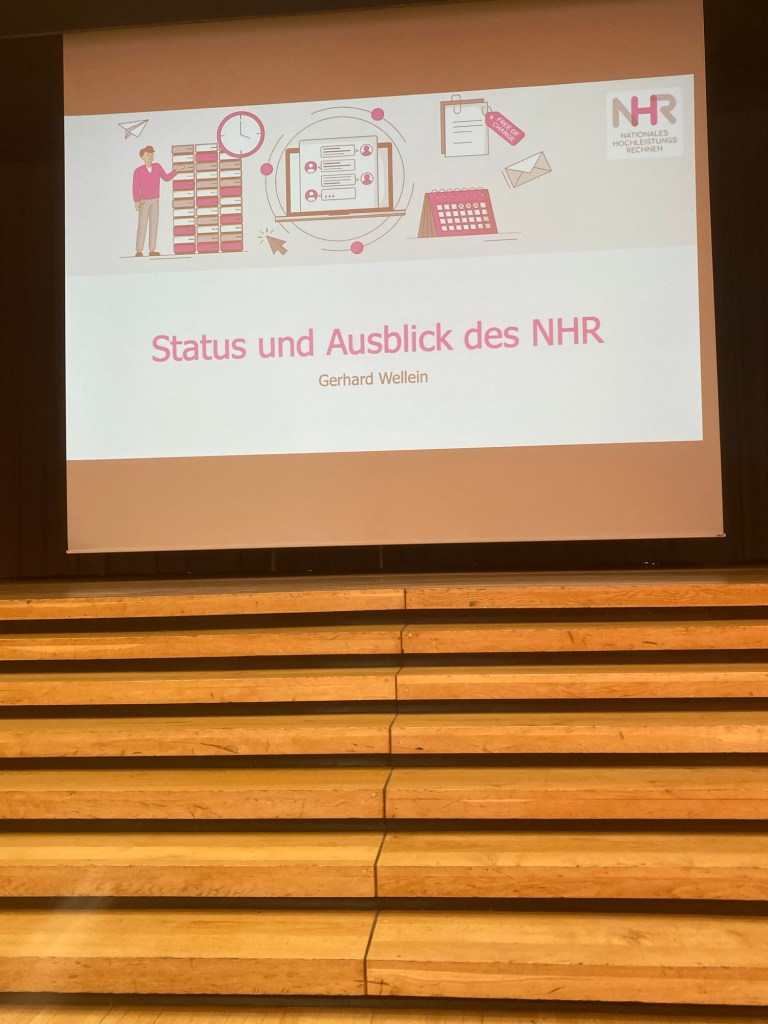
Prof. Gerhard Wellein did the same for NHR , the association of the tier-2 centres.
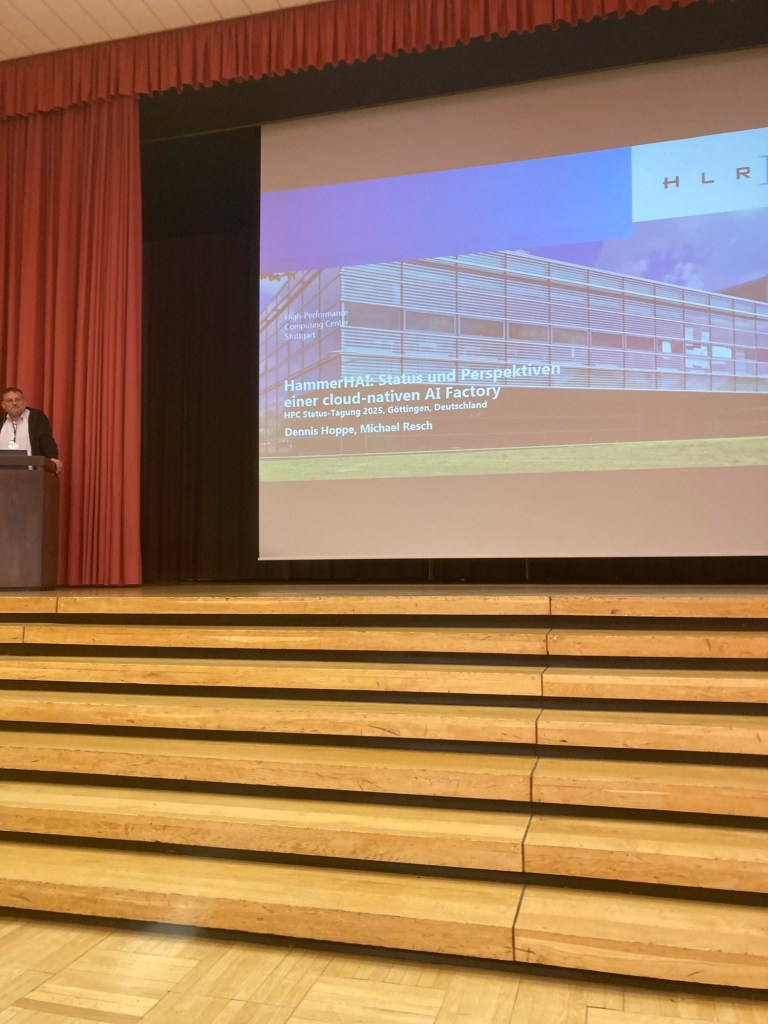
Prof. Resch again (replacing Dennis Hoppe who had an accident with his child 😉 talked about „HammerHAI: status und perspectives of a cloud-native AI factory“: last year, the EU issued a very short-term call for AI factories: the first one in Germany went to HLRS.
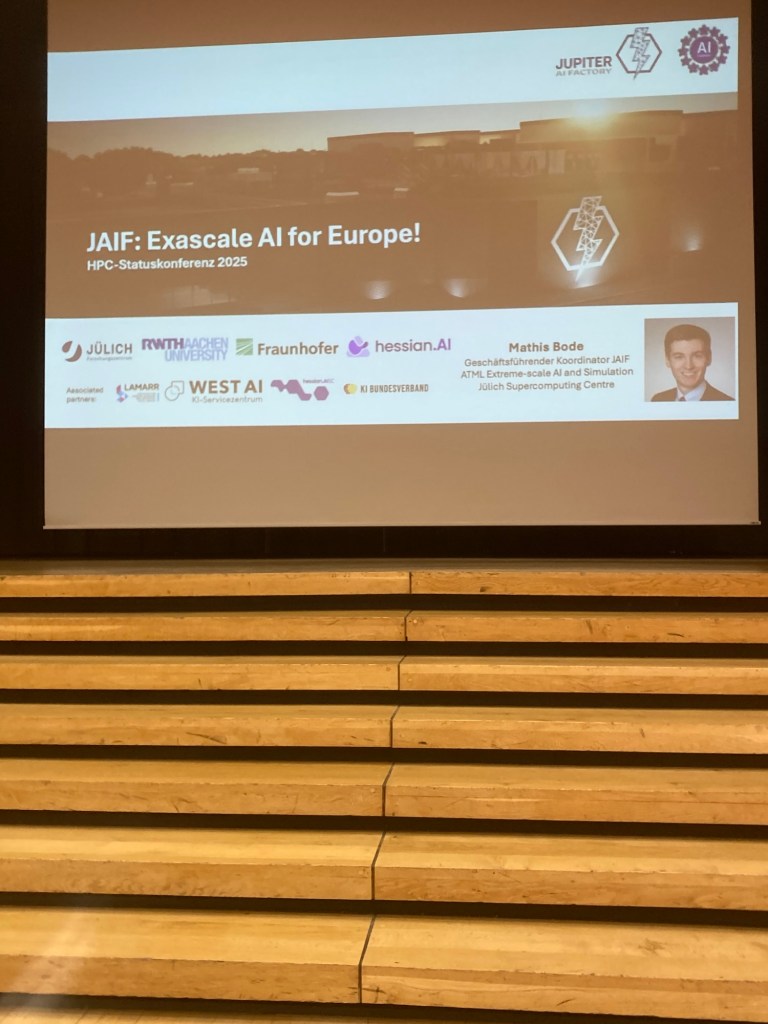
Mathis Bode presented „JAIF: Extreme-scale AI for Europe“: he started his talk with a short presentation on Jupiter, the first European exascale system installed at JSC@FZJ. JAIF is the second AI factory in Germany. Currently there is an call of the EU open for so-called Giga factories. Chancellor Merz said during the Jupiter inauguration ceremony: „Let‘s get at least one Giga factory to Germany!“ (see also the short video on UTube and the long video – caution: more than one hour and a half!)
Btw: the full agenda of the conference can be found here.
The first day ended with a short discussion on the national HPC and the EuroHPC AI factories.
Side remark: in the evening I went for dinner to El Punto, the best Spanish restaurant / tapas bar I have ever been to. 😋
An anecdote: Tuesday morning (I have also been to the NHR conference before, see my report also tbp on HPCsquAIre.org) when I was waiting for the bus I saw this:
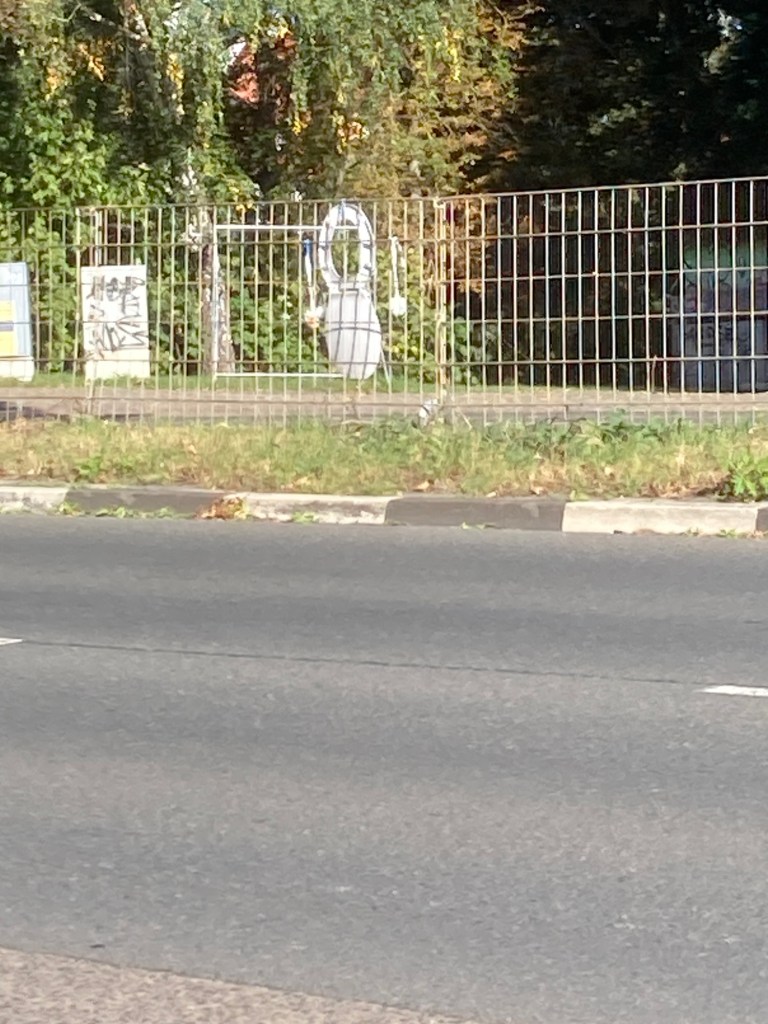
The following morning, the toilet seat and the two toilet brushes were gone:
On Thursday, I skipped the morning sessions, so I missed the short opening speech from the BMFTR (ministry for research, technology and space that is funding many of the projects reported) and the session on SCALEXA with the subsessions „Multi-skalen Codes mit gekoppelten Ebenen“, „Synergie bei CFD/matrixfreien Algorithmen“ and „Ansätze zur Nutzung von heterogener Hardware und smarten Netzwerken“.
On my way to the bus station I saw the following:

„Your municipality will be a digital forerunner.“ – To explain: digitalization is a big problem in Germany 🇩🇪, e.g. see the book by Michael Resch (again 😉 with the title „Digitalwüste Deutschland“ [digital desert Germany] which I recommend to read.
So I continued (as every day of the week) my way to the „Aula am Waldweg“ by bus (having the opportunity to see the beautiful old city of Goettingen from inside the bus – it was almost like a sightseeing tour 😉 and arrived just in time for lunch 🥙. 😉
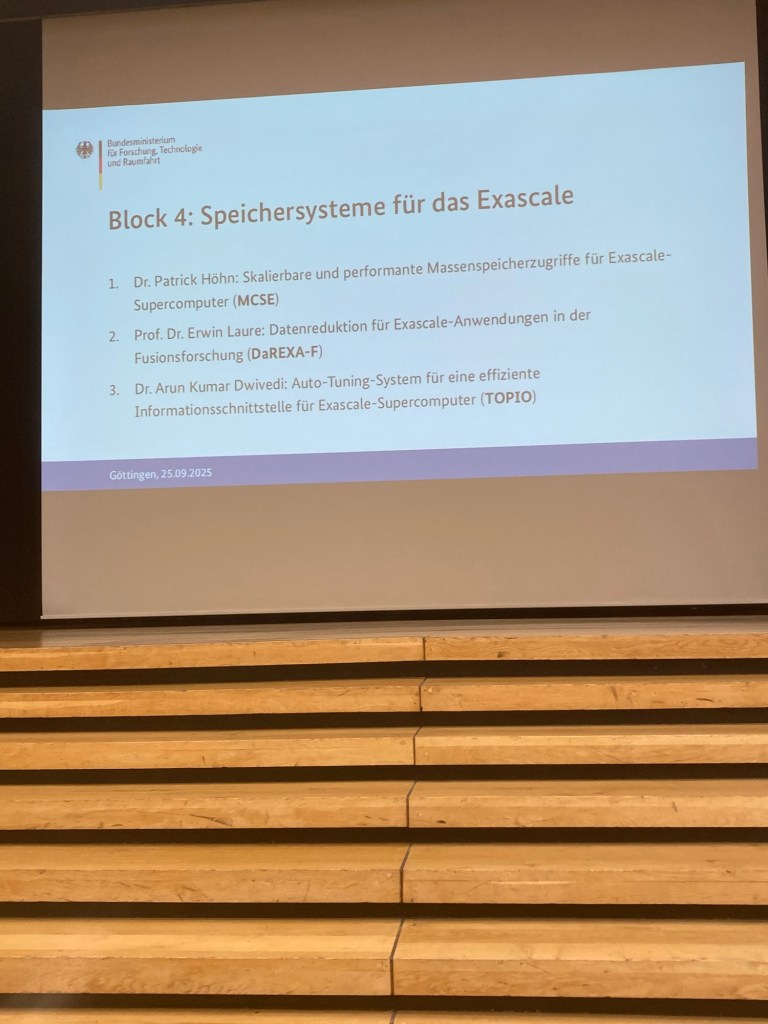
The afternoon started with a session on storage systems for exascale: Prof. Erwin Laure of MPCDF, Dr. Patrick Höhn from the university of Goettingen and NN reported on their systems and special use cases of high-end storage.
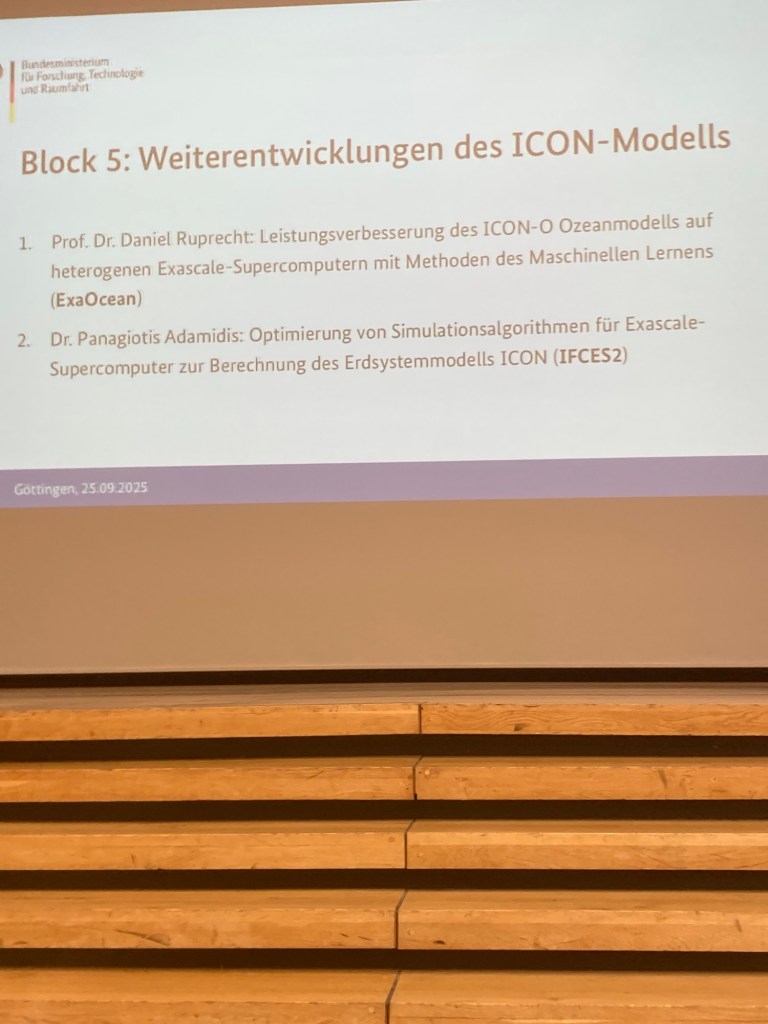
This was followed by a session on further developments of the ICON model: this is the current state-of-the-art for climate research as well as for weather forecast worldwide. Prof. Daniel Ruprecht from the technical university of Hamburg and Dr. Panagiotis Adamidis from DKRZ talked about their work on ICON (sorry I do not remember a lot from their talks).
After the following coffee break the second day was continued with a session on green HPC:
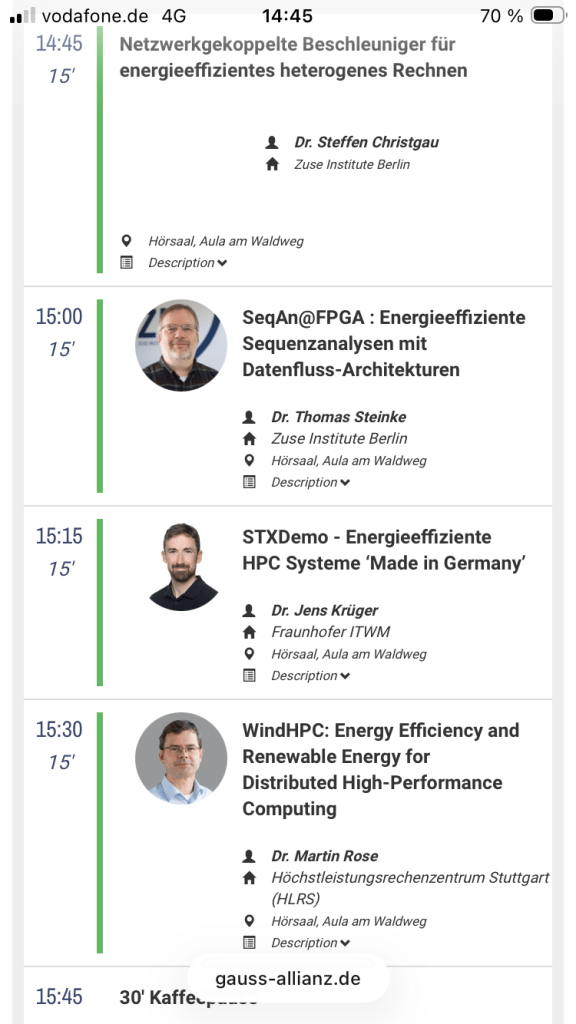
Dr. Steffen Christgau from ZIB talked about NAAs for energy-efficient heterogeneous computing.
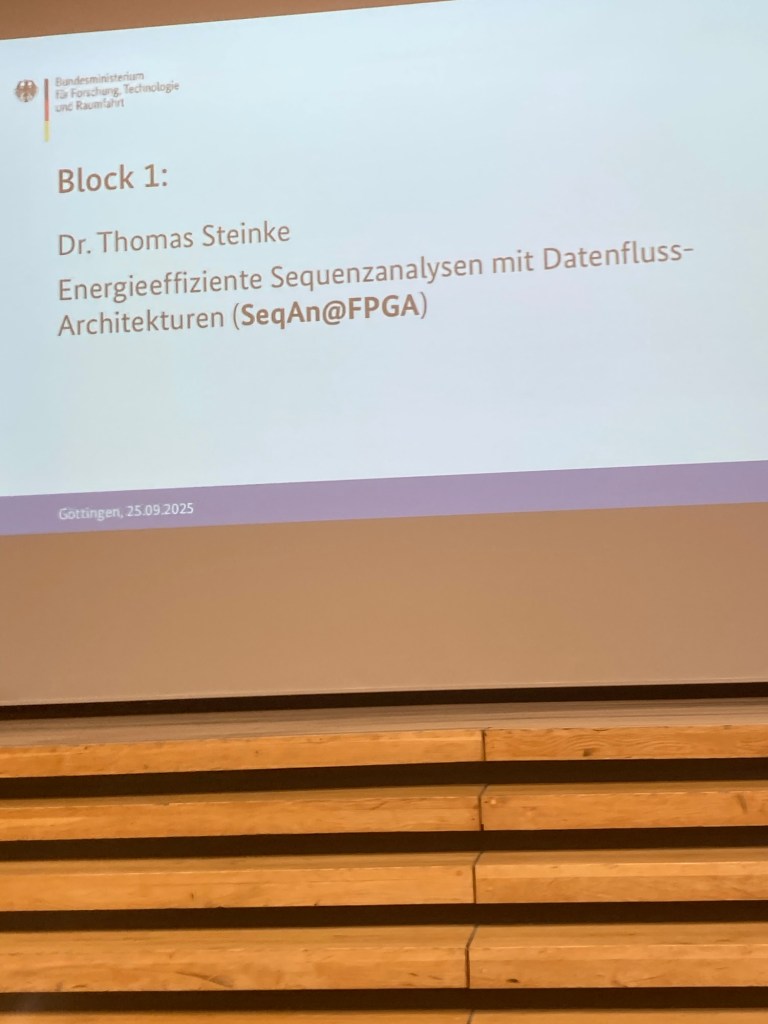
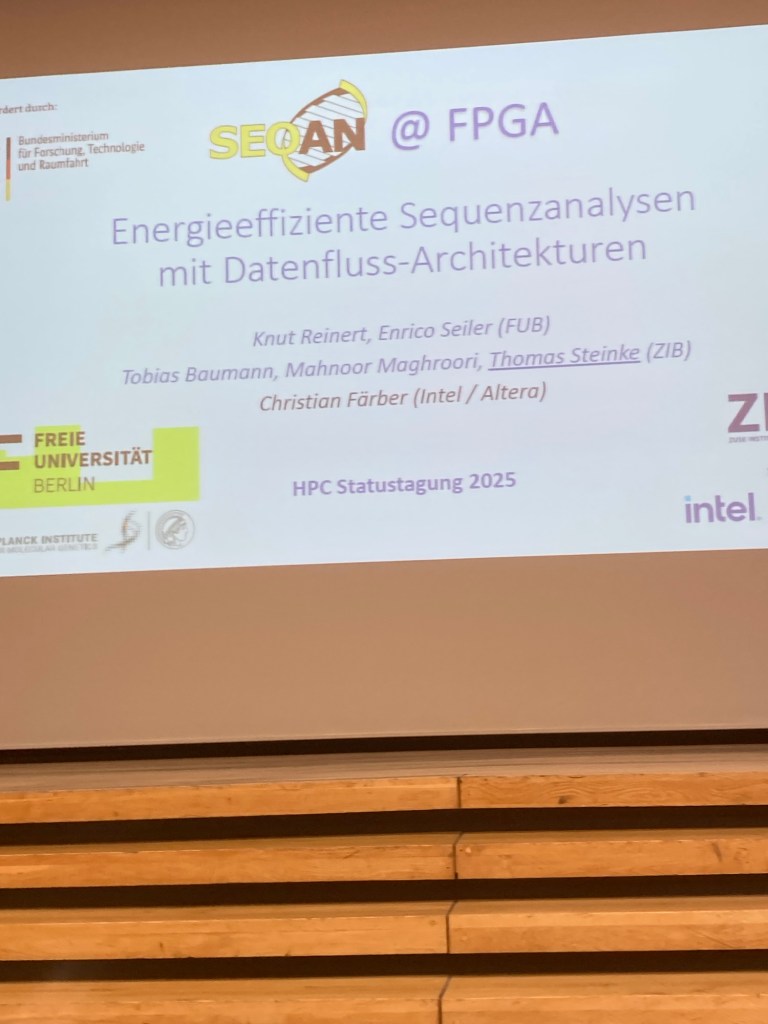
My friend Dr. Thomas Steinke (also from ZIB) gave a talk titled „SeqAn@FPGA: energy-efficient sequence analyses with data flow architectures“,
Dr. Jens Krüger from Fraunhofer/ITWM presented „STXDemo – energy-efficient HPC systems made in Germany“: this is an accelerator for stencil operations, so a pretty wide application area for traditional HPC. During a break before I had talked to Franz-Josef Pfreundt about this project: he said he is waiting for further funding.
Btw: before joining ITWM FJP was at the university of Kaiserslautern which was one of the first nCUBE customers [see below]). During the same break I was sitting with FJP, NN and Michael Resch: it was a great pleasure and honor to speak with the latter.
Then Dr. Martin Rose from HLRS presented the WindHPC project: the basic idea is to install HPC systems in the basement of wind wheels. I found the last talk/project very interesting, hence I asked two questions: 1. since the space in the basement of a wind wheel is limited: how much compute power can one install? And 2. bringing the compute power to the place where the energy is generated leads to the question: how do you bring the compute power to the user? Answer 1: there is enough room to house for example Hawk, the previous high-end system at HLRS. Answer 2: this is not a problem because the WindHPC can be connected with GbE to the rest of the world. This all sounds pretty/very promising.
Because of my health problems mentioned I left after the following coffee break and skipped the rest second session on green HPC:
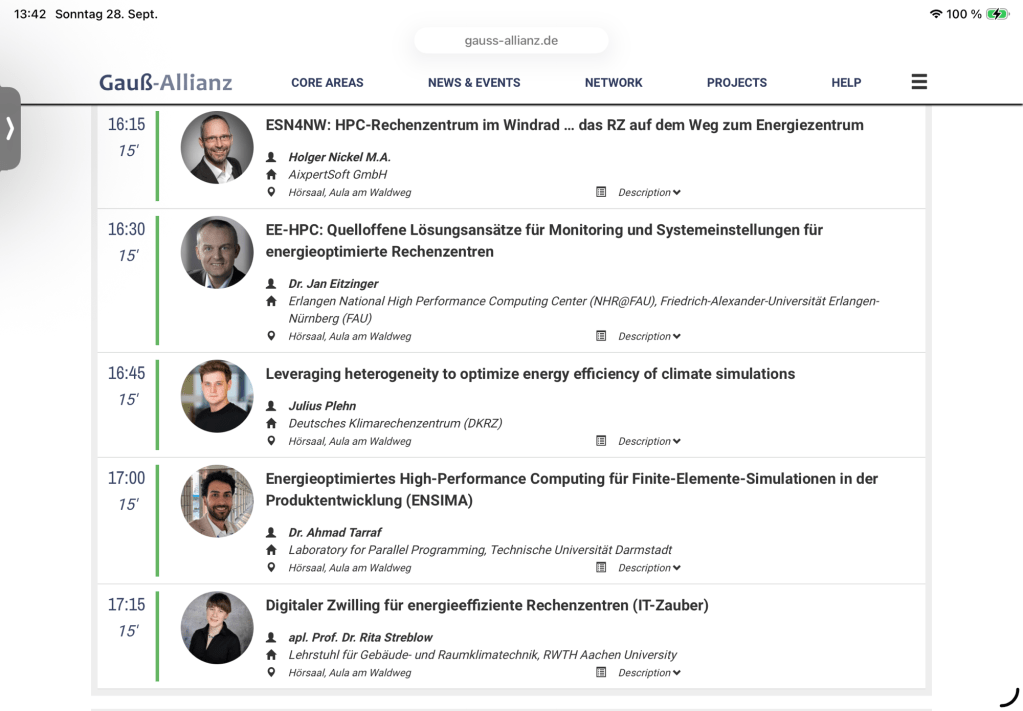
Btw: abstracts of all / most of the presentations can be found in the agenda.
When I returned to the hotel (I needed a rest before the stressful 😉 evening event) a bad surprise awaited me: the second lift was out of order, so had to climb the steps to my room on the third floor. Hence I wrote an ugly review on Google Maps…
The receptionist told me that he called the elevator company, but both lifts where still out of order when I had to leave the hotel at 6:30pm for the dinner at the GWDG computing center. It was not a big problem for me to go down the stairs.
When I left the receptionist told me that hopefully the elevators will be fixed when I return.
I ordered a taxi with the taxi.eu app (Uber did not work). It arrived quickly (Erwin Laure shared the taxi with me, during the drive we had a nice conversation, e.g. on Hermann Lederer: one of the first nCUBE (the first HPC vendor I worked for) customers in Germany was the IPP in Garching). But at the end there was a problem: the taxi driver said it is not possible to pay via the app, he even did not understand what I meant. He called the main office, and they told him: „cash or card“. So, I paid by credit card. This is the digital desert Germany (see above).
Having arrived at the GWDG computing center I was impressed by the new building: in the early nineties I have been many times to the old building because GWDG was one of the German customers of Kendall Square Research, the second HPC vendor I worked for. Working for KSR was my first „Griff ins Klo“ during my professional career, working for T-Platforms was the second one, but that is a different story…
Anyway: the ambiance at the new building was very nice, „alles vom Feinsten“, including e.g. a coffee bar which unfortunately was closed. 😕
Because of my health problems I am drinking no alcohol for more than a year now, but they had a very good alcohol-free beer 🍺 from Einbecker.
I left the „party“ at about 9:30pm 🕤, ordered a taxi by phone because the waiting time on taxi.eu was too long. The taxi driver was very chatty: when I told him about the problem with the elevators at the hotel he complained about the situation in Germany: nothing is working, and the politicians are failing. – I gave him a big tip.
When I arrived at the hotel the elevators were still out of order. The receptionist excused for that, and said that the technician will come next morning at 7am 🕖. So I had to climb the stairs again, but at least I slept very well. 😴 💤
The following morning, I wanted to take the elevator at about 9am 🕘 but it was still out of order. 😡 So, I had to walk downstairs, at least for the last steps from first to ground floor a guy from the cleaning team helped me with my luggage 🧳 – very kind!
I skipped the early morning session of the third and final day (including the. keynote: „Towards in silico Neuroscience“ by Fabian Sinz, professor for macchine learning at the university of Goettingen, came late to the second: Christian Terboven of RWTH Aachen talked about the offerings of the German AI service centres – sorry for the fuzzy picture:
He or Julian Kunkel mentioned another conference:
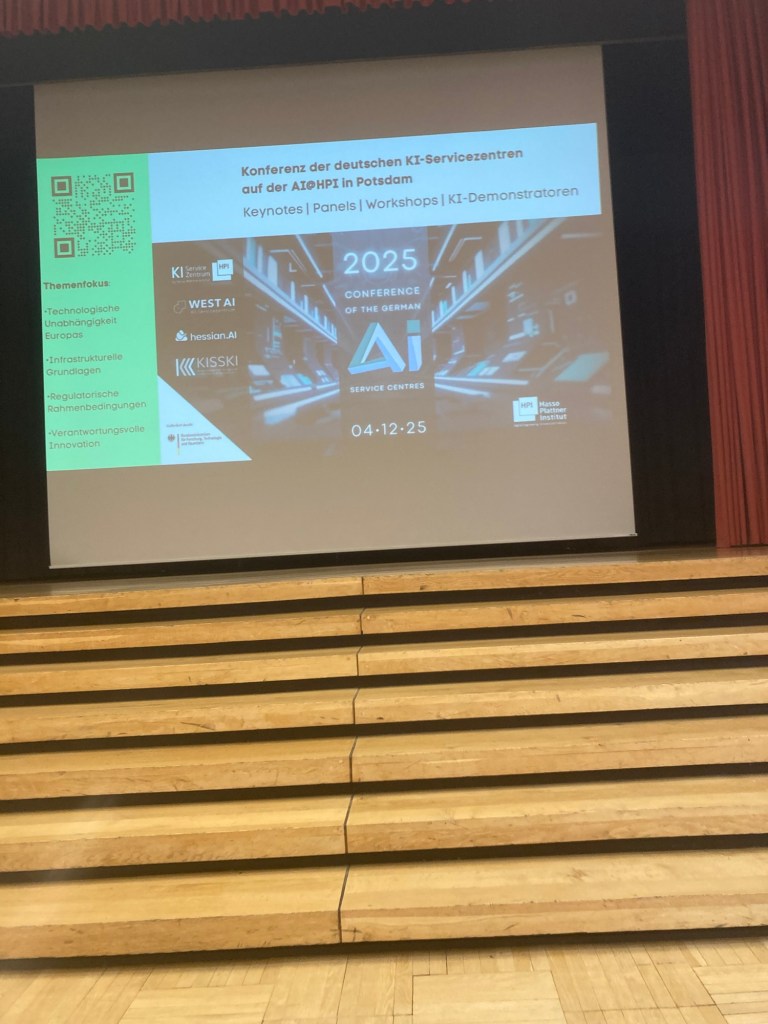
Afterwards Prof. Sören Auer from L3S talked about responsible neuro-symbolic AI and applications at his research center.
The following talk was not „Produktive KI Workflows in der UMG – HPC ist essentiell“ [productive AI workflows at UMG – HPC is essentia], but Jakob Dieterle of GWDG again gave a presentation on SecureHPC in medicine. After this talk I took the microphone 🎤 and said that especially in medicine data security is very important. In addition, I asked JD if he would be willing to participate in the next ISC, e.g. in form of a BoF Session: Eric Schnepf, the programme manager of the ISC group had asked me to look after potential contributors for the topic „Cybersecurity in HPC and AI“. JD said „yes“. 🙂
The final session was a panel discussion under the title „Goldgräberstimmung in der KI – Vergessen wir unsere Stärken im HPC?!” [gold digger mood in AI – do we forget our strengths in HPC?!]
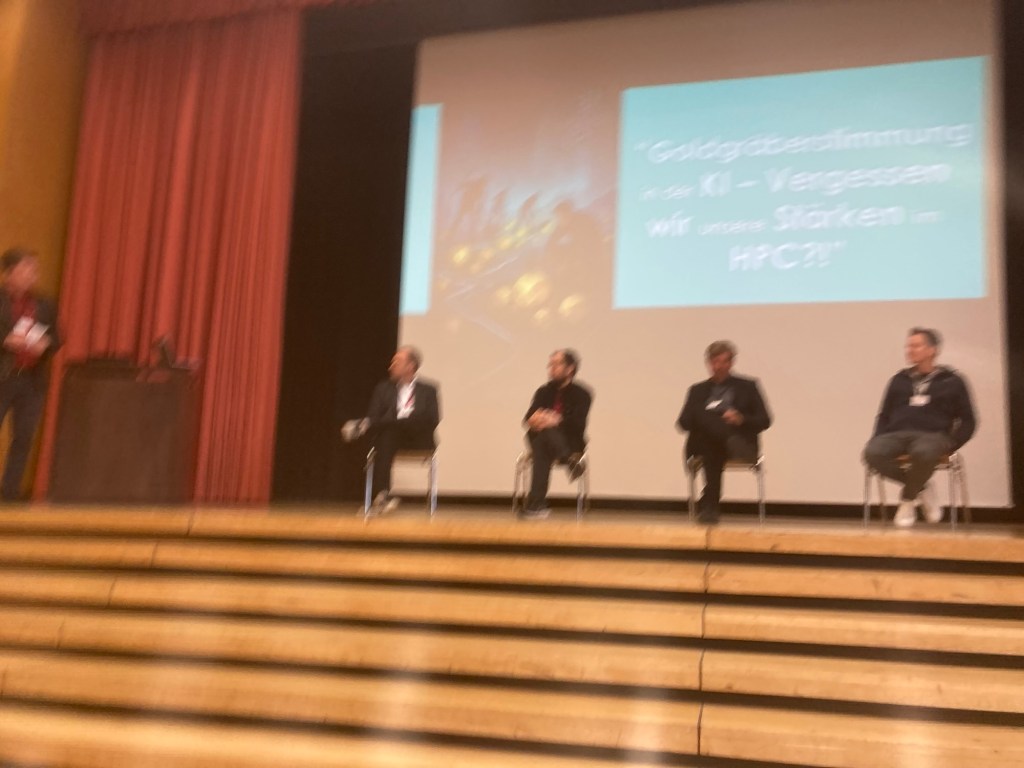
Sorry again for the fuzzy picture!
Under the moderation by Josef Weidendorfer the particpants (Christian Terboven, Julian Kunkel, Sören Auer, Christopher Kadow) discussed various related topics, e.g. the fact that Nvidia will drop double-precision support in their next GPUs because of the dominance of AI vs traditional HPC.
A common understanding of (almost) all particpants (not only of this panel but also other speakers) was that HPC and AI are not competing but complementing each other. A few years ago, people were talking about the convergence of HPC and AI. One speaker – I think it was Michael Resch – said that AI is just another although (very) important „method“ of HPC. A while ago, I said in an internal presentation at my former and last employer SICOS BW GmbH that HPC and AI is using more or less the same hardware. This is changing now, see what is said about Nvidia. Nevertheless: HPC and AI are not contradicting topics/subjects many HPC applications have been improved by AI.
The conference was finished with closing remarks by Simon Hechinger from BMFTR and Prof. Wolfgang Nagel.
After the conference programme was over I was having a last and final lunch 🥙 and talking to Sören Auer et al about „a different economy system“ (SA mentioned this in the panel discussion, I asked what he meant by this), taxing robots, project 2025, Peter Thiel etc. So, at the end the discussion became political…
Summary: this conference was worth the time and money. Thanx a lot to Jens Lukaschkowitz of GA, the whole GWDG team and last but not least Schaumbergs for the excellent catering. 🙏
Epilog: Since the conference ended earlier than initially planned I had booked a train at 5:02pm. So, I spent quite some time at the railway station, watching people in the concourse, having onion rings at Burger King, buying some pastries for the train ride, waiting for the train:

Bye bye Goettingen!
After a train ride of a little less than four hours I arrived a few minutes ofter 9pm 🕘 in Munich, just twenty minutes late – this is (very) good for the Deutsche Bahn. 😉
-$tr250928
 introducing: HPCsquAIre(*)